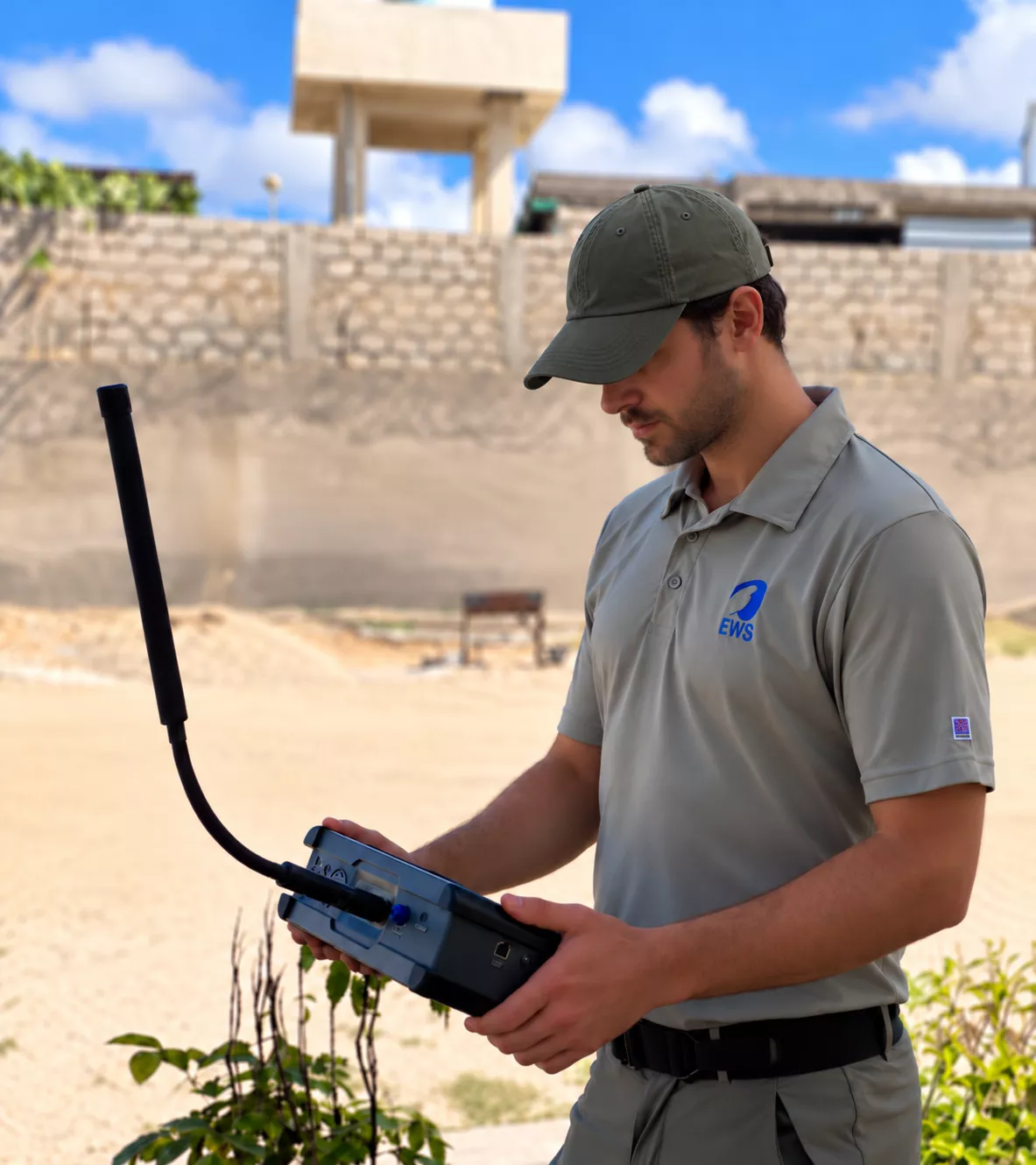
For decades, EW was the preserve of specialist units and classified programmes. That has changed. Commercial drones, satellite navigation jamming and radio-controlled improvised explosive devices have brought the spectrum into everyday security planning, for militaries, governments, NGOs and businesses alike.
At EW Solutions (EWS), electronic warfare and Cyber and Electromagnetic Activities (CEMA) are all we do. Our team of former military operators, analysts and engineers has supported governments, armed forces and agencies in more than 25 countries. This guide draws on that experience to explain what EW is, how it works and why it matters today.
New to the subject? Our Electronic Warfare for Non-Specialists course builds the fundamentals in a practical, jargon-free way.
Every modern operation depends on the electromagnetic spectrum. It is the range of energy that carries radio and mobile phone signals, radar, satellite navigation, data links, infrared and visible light. If a device transmits or receives, it lives in the spectrum.
That makes the spectrum both a lifeline and a vulnerability. Forces need it to talk, navigate, find targets and control drones. Adversaries know this, and they will try to listen in, locate emitters, jam links or feed in false signals.
Electronic warfare is the discipline of winning that contest. In practice, it has three aims:
Get it right, and commanders see more, communicate securely and act faster. Get it wrong, and radios fall silent, drones fly blind, and positions are given away by a single careless transmission.
You will see both terms. The UK and NATO now generally use "electromagnetic warfare", which better reflects that the discipline spans the whole spectrum, not just electronics. The abbreviation, EW, and the principles stay the same. In this guide, we use "electronic warfare", the term most people still search for, and the two can be read as interchangeable.
Electronic warfare is traditionally split into three divisions. Each has a distinct job, but they work best as one joined-up effort.
In short, Electronic Surveillance (ES), also called Electronic Support, finds, intercepts, identifies and locates signals, such as detecting a drone's control link and pinpointing its operator. Electronic Attack (EA) denies, degrades or deceives an adversary's systems, for example by jamming a radio-controlled IED before it can be triggered.
Electronic Defence (ED), also called Electronic Protection, keeps your own systems working under threat. That might mean changing frequencies or limiting emissions to avoid detection and jamming.
Electronic Surveillance is about listening and understanding. Operators search the spectrum, intercept transmissions, identify what type of equipment is producing them and use direction finding to work out where they are coming from.
This builds a picture of who is operating in an area and what they are likely to do next. It feeds directly into intelligence, force protection and targeting. Good ES is often the difference between reacting to a threat and getting ahead of it.
Electronic Attack uses electromagnetic energy to stop an adversary from using the spectrum effectively. The most familiar form is RF jamming, which drowns out a signal with noise. More sophisticated techniques include deception and spoofing, where false signals are used to mislead receivers such as satellite navigation systems.
EA is powerful, but it is never a free-for-all. A jammer does not know whose radio it is blocking. Every attack has to be planned and coordinated so it does not disrupt friendly communications, sensors or civilian services.
Electronic Defence (ED), known in the UK as Electronic Defence and in NATO and US doctrine as Electronic Protection (EP), keeps your own forces able to operate when someone else is trying to stop them. It includes emission control, frequency hopping, resilient equipment and disciplined procedures.
It also covers protection from your own side. When friendly electronic countermeasures are running, communications and sensors still need to work.
All three divisions share one thing in common. Technology can automate a great deal, but it takes skilled, well-trained operators to read a crowded spectrum and make the right call under pressure. That is why our EW and CEMA training courses put practical, intelligence-led learning at the centre.
Cyber and Electromagnetic Activities (CEMA) is the UK approach to planning electronic warfare, cyber operations, signals intelligence and spectrum management as one integrated effort, rather than four separate ones.
The logic is simple. A drone's control link, a radio network and a computer system increasingly share the same signals, devices and data. A jammer, a cyber operation and a SIGINT collection task may all be aimed at the same target. Planned in isolation, they can get in each other's way. Planned together, they create effects that none could achieve alone.
You may also come across Electromagnetic Spectrum Operations (EMSO), the wider term used across NATO and the US for all military activity in the spectrum. Whatever the label, the principle is the same: treat the spectrum as an operating environment in its own right.
This convergence sits at the heart of what EWS does. It is also why we built our CEMA training, intelligence and consultancy to work together rather than as stand-alone services. You can read more about how CEMA consultancy supports operational readiness.
Signals intelligence (SIGINT) is intelligence gathered from intercepted signals. It has two main branches:
SIGINT and Electronic Surveillance overlap heavily. ES gives operators an immediate tactical picture, while SIGINT turns that data into longer-term intelligence. Our Electronic Warfare & Signals Intelligence course develops both skill sets side by side.
The spectrum is finite and crowded. Friendly radios, data links, radars, jammers and civilian services all compete for the same bands. Spectrum management is the planning and coordination that stops them from interfering with each other.
In an EW context, this includes deconflicting Electronic Attack so it does not knock out friendly communications. It is one of the least glamorous parts of CEMA and one of the most important. When it fails, the first casualty is usually your own command and control. Our spectrum management training covers frequency coordination, link analysis and interference mitigation in operational settings.
Electronic warfare is no longer confined to fast jets and warships. Some of the clearest examples today involve low-cost technology in the hands of state and non-state actors alike.
Most drones rely on radio links for control and video, and many depend on satellite navigation to fly. That makes them a natural EW target. Counter-drone systems detect and locate those links, then jam or spoof them to force the drone to land, return or drift off course.
The challenge is that the threat moves fast. Off-the-shelf drones are modified, frequencies change, and new control methods appear constantly, across air, ground, surface and underwater vehicles (collectively, UxVs). Staying effective means tracking those changes. Our OverSite UxV threat intelligence does exactly that, and our counter-UxV training turns it into practical defeat skills.
Global Navigation Satellite System (GNSS) signals, including GPS, are extremely weak by the time they reach the ground. A relatively low-power transmitter can drown them out (jamming) or feed receivers false positions (spoofing).
The effects reach well beyond the battlefield. Ships, aircraft, vehicles and timing systems for critical infrastructure all rely on GNSS. Widespread interference in parts of Europe and the Middle East has turned it from a military concern into a commercial and civil one, with consequences for shipping, aviation and insurers.
Radio-controlled improvised explosive devices (RCIEDs) use everyday transmitters, from car key fobs to mobile phones, to trigger a device remotely. Electronic countermeasures (ECM) protect patrols, convoys and explosive ordnance disposal (EOD) teams by blocking the signals that would set them off.
ECM is only as good as the threat knowledge behind it. Systems need to be configured for the transmitters actually in use in a given region, and operators need to understand how adversaries adapt. Our Open Source Threat Database (OSTD) records IED and RCIED events worldwide and is updated daily, while our C-IED training prepares teams to apply that knowledge on the ground.
The war in Ukraine has shown how central electronic warfare has become. Both sides rely heavily on drones and satellite navigation, and both have invested in jamming and spoofing to counter them. Tactics and countermeasures evolve in weeks rather than years, and units that cannot adapt in the spectrum quickly lose the ability to see, communicate and strike. The UK Parliament's briefing on electromagnetic warfare sets out what this means for the UK.
You do not need to be an EW operator to need EW literacy. Anyone who plans operations, manages risk or buys capability in a contested environment benefits from understanding how the spectrum shapes outcomes.
Decision-makers who understand the spectrum ask better questions, plan more realistically and spend more wisely. That is exactly why we created EW training for non-specialists. The course gives commanders, analysts, managers and support staff a clear grounding in Electronic Surveillance, Electronic Attack and Electronic Defence, the intelligence cycle, EW threats and spectrum management, without assuming an engineering background.
Capability in the spectrum is never just about equipment. It comes from trained people, current intelligence, sound decisions and systems that keep working in the field. EWS brings these elements together through specialist training delivered at our UK facilities or on-site anywhere in the world. As a vendor-agnostic provider, we work with a range of technologies and systems, ensuring our training focuses on practical, real-world capability rather than specific manufacturers or equipment.
Our electronic warfare training spans more than 120 tailored courses, from EW fundamentals to signals intelligence, C-IED, counter-UxV, spectrum management and doctrine. Courses run at our UK facilities or on-site anywhere in the world, using your own systems where possible. Every course draws on our live intelligence databases, so scenarios reflect the threats your people will actually face.
Our EW intelligence services turn open-source information into actionable insight. Our analysts monitor more than 150 countries: OSTD records IED and RCIED activity, and OverSite tracks UxV threats and tactics. Clients use this intelligence for threat assessment, operational planning and countermeasure development, and it underpins everything else we deliver.
We are vendor-agnostic. Our EW and CEMA consultancy helps governments, armed forces and industry assess current capability, shape requirements, support procurement and stress-test plans through red teaming. Our advice is grounded in operational experience and focused on what your mission needs, not on what someone wants to sell.
When systems are deployed, our EW engineering and field support teams keep them effective. From ECM field trials and mission fill support to counter-UAS services and system integration, our engineers work on site or remotely, including in austere and high-risk environments.
The three divisions are Electronic Surveillance (ES), Electronic Attack (EA) and Electronic Defence (ED). ES finds and identifies signals, EA denies or deceives an adversary's systems, and ED keeps your own systems working. ES and ED are also known as Electronic Support and Electronic Protection.
Common examples include jamming a drone's control link, spoofing GPS signals, using electronic countermeasures to block radio-controlled IEDs, and locating enemy radios or radars through direction finding. Protecting your own communications from interception is also electronic warfare.
Electronic warfare targets signals travelling through the electromagnetic spectrum, while cyber warfare targets computer systems, networks and data. The two increasingly overlap, which is why the UK plans them together under CEMA.
No. Using a jamming device in the UK without authorisation is a criminal offence under the Wireless Telegraphy Act 2006, enforced by Ofcom. Jamming is reserved for authorised users such as the armed forces and certain government agencies, operating under strict controls.
The best starting point is a structured introductory course. Our Electronic Warfare for Non-Specialists course covers the essentials of EW, SIGINT and spectrum management without assuming a technical background.